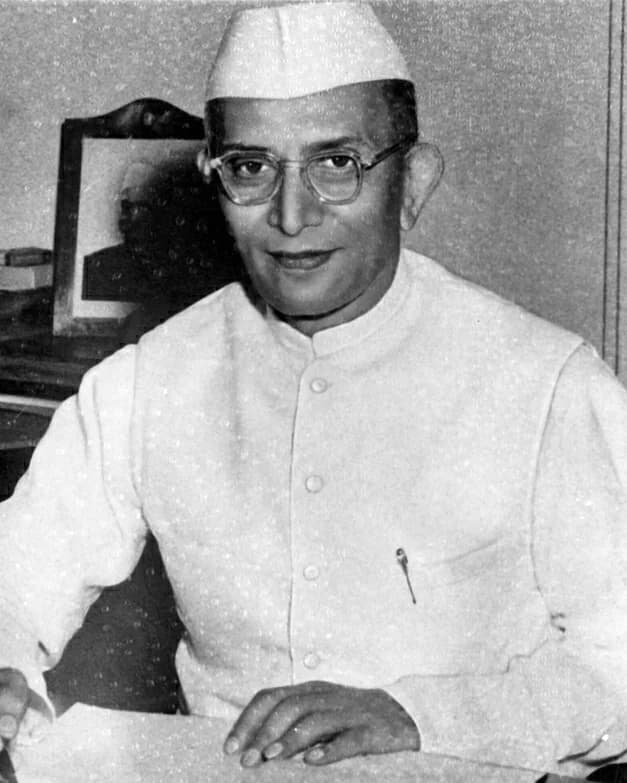
Morarji Desai
- Date of birth
- 29 February 1896
- Place of birth
- Bhadeli, Bulsar district, Gujarat, India

Morarji Desai was born on 29 February 1896 in Bhadeli village, now in the Bulsar district of Gujarat. His father was a school teacher. He passed his matriculation at St. Busar High School, studied at Wilson College in Bombay, and served as a Deputy Collector in the Bombay Province for twelve years. He married Gujraben in 1911; of their five children, one daughter and one son were surviving when the Prime Minister’s Office biography was written.
In 1930 Desai resigned from government service to join the freedom struggle led by Mahatma Gandhi. He was imprisoned three times, became a member of the All India Congress Committee in 1931 and was Secretary of the Gujarat Pradesh Congress Committee until 1937. When the first Congress government took office in Bombay Province in 1937 he became Minister for Revenue, Agriculture, Forest and Co-operatives. He was detained during the individual Satyagraha and again during the Quit India Movement, and was released in 1945. After the 1946 elections he became Minister for Home and Revenue, introducing land revenue reforms that gave tenants security. He became Chief Minister of Bombay in 1952.
After the reorganisation of the states, Desai joined the Union Cabinet as Minister for Commerce and Industry on 14 November 1956 and took the Finance portfolio on 22 March 1958. He resigned from the Cabinet in 1963 under the Kamaraj Plan and later chaired the Administrative Reforms Commission at the request of Lal Bahadur Shastri. In 1967 he joined Indira Gandhi’s Cabinet as Deputy Prime Minister and Finance Minister. On 16 July 1969 she took the Finance portfolio from him and he resigned from the Cabinet. When the Congress split later that year he remained with the Organisation Congress and led opposition to the government.
Desai was re-elected to Parliament in 1971. In 1975 he went on an indefinite fast over the holding of elections in Gujarat, which were then held in June. He was arrested on 26 June 1975, when the Emergency was declared, and released on 18 January 1977. After the Janata Party’s victory in the March 1977 general election, in which he was elected from Surat in Gujarat, he was chosen leader of the Janata Party in Parliament and sworn in as Prime Minister on 24 March 1977. He remained in office until 28 July 1979.
After leaving office Desai retired to Bombay. He died there on 10 April 1995 at the age of 99, according to The Independent’s obituary. The President’s Secretariat notified the Bharat Ratna for him on 26 January 1991.
| Period | Position | Organisation | Region |
|---|---|---|---|
| 24 March 1977 – 28 July 1979 | Prime Minister of India | Government of India | India |
| — | Deputy Prime Minister and Minister of Finance | Government of India | India |
| 22 March 1958 | Minister of Finance | Government of India | India |
| 14 November 1956 | Minister for Commerce and Industry | Government of India | India |
| — | Chairman, Administrative Reforms Commission | Government of India | India |
| — | Chief Minister of Bombay | Government of Bombay | Bombay |
| — | Minister for Home and Revenue, Bombay | Government of Bombay | Bombay |
| — | Member of Parliament, Lok Sabha | Lok Sabha | Surat |
| Year | Election | Constituency | Party | Result | Votes received | Margin |
|---|---|---|---|---|---|---|
| 1977 | Lok Sabha | Surat | Janata Party | won | — | — |
- 1991Bharat RatnaAwarded India’s highest civilian honour; notification dated 26 January 1991.
- Land revenue reforms in BombayIntroduced security of tenancy rights for tenants as Minister for Home and Revenue.