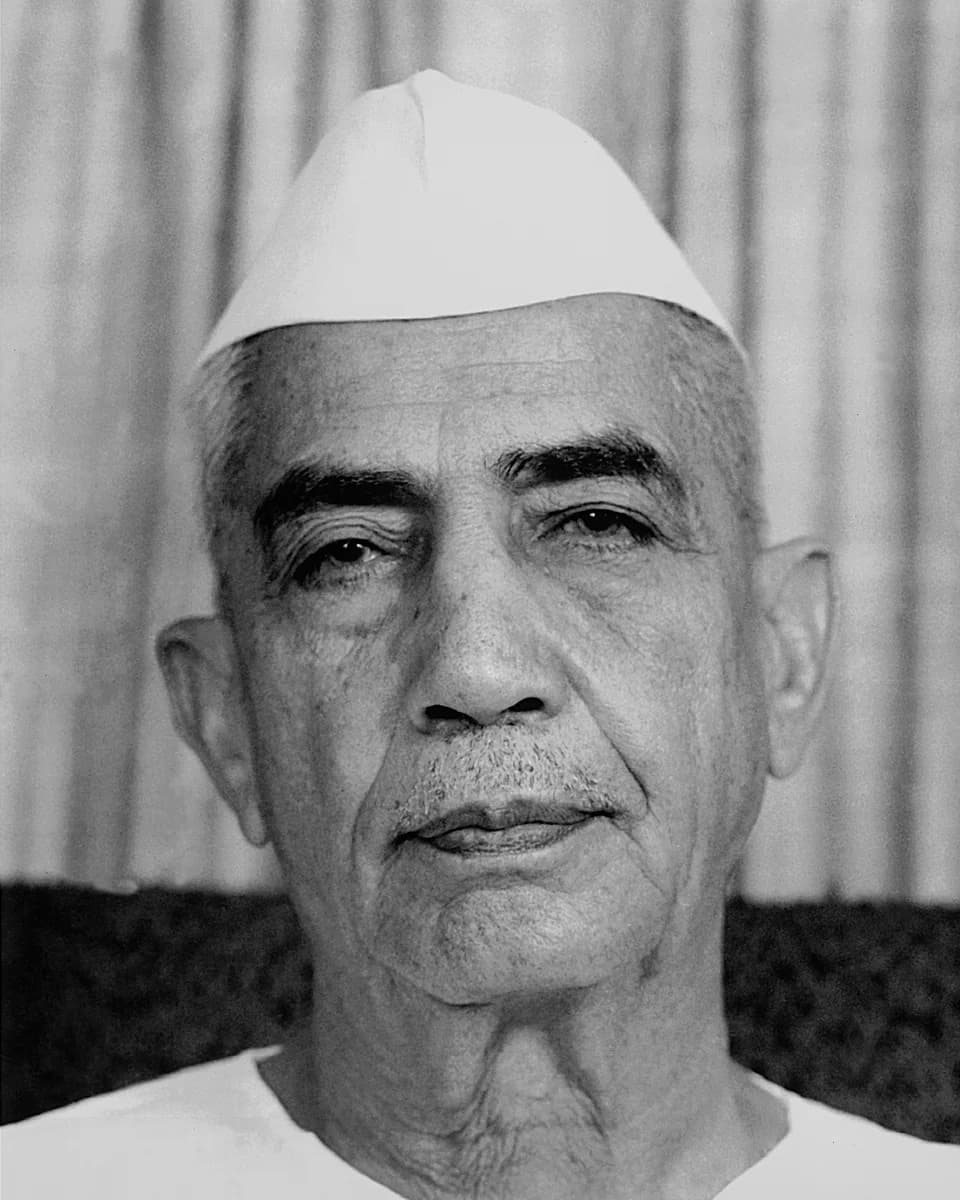
Charan Singh
- Date of birth
- 23 December 1902
- Place of birth
- Noorpur, Meerut district, Uttar Pradesh, India
Updated
Photo: Charan Singh Archives / Wikimedia Commons (CC BY-SA 4.0)

Charan Singh was born in 1902 at Noorpur in Meerut district of Uttar Pradesh, in a middle-class peasant family. He graduated in science in 1923 and completed his postgraduate studies at Agra University in 1925. Trained in law, he set up practice at Ghaziabad, moved to Meerut in 1929 and later joined the Indian National Congress. The Charan Singh Archives record his birth date as 23 December 1902, though one press account gives the year as 1903; this profile follows the Prime Minister’s Office on the year.
Charan Singh was first elected to the Uttar Pradesh Legislative Assembly in 1937 from Chhaprauli and represented the constituency in 1946, 1952, 1962 and 1967. He became Parliamentary Secretary in Govind Ballabh Pant’s government in 1946 and Cabinet Minister for Justice and Information in June 1951. In 1954 he became Minister for Revenue and Agriculture under Sampurnanand, resigning in April 1959. He was Minister for Home and Agriculture in 1960 under C. B. Gupta, Minister for Agriculture and Forests in 1962 and 1963 under Sucheta Kripalani, and took charge of Local Self-government in 1966. The Prime Minister’s Office credits him with a leading role in land reform in the state, including the Debt Redemption Bill of 1939 and the Land Holding Act of 1960.
After the 1967 Assembly elections Charan Singh left the Congress with a group of MLAs and was sworn in as Chief Minister on 3 April 1967, heading a coalition of opposition parties under his newly formed Bharatiya Kranti Dal. The Indian Express describes him as the state’s first non-Congress Chief Minister. That government ended in February 1968. He returned as Chief Minister on 18 February 1970 with the support of the Congress (R) after the Congress split, and left office in the first days of October 1970, when President’s Rule was imposed.
Charan Singh lost the 1971 Lok Sabha contest at Muzaffarnagar but won Baghpat in 1977 on a Janata Party ticket and became Deputy Prime Minister in the government led by Morarji Desai. He later left the Janata Party to form the Janata Party (Secular) and took office as Prime Minister on 28 July 1979 with Congress support. He resigned on 20 August 1979, after 23 days, when the Congress withdrew its support, and in a statement said he would not withdraw prosecutions relating to the Emergency in return for support. He remained in office until 14 January 1980.
Charan Singh won Baghpat again in the 1980 and 1984 Lok Sabha elections and died in Delhi on 29 May 1987. He wrote several books and pamphlets, including Abolition of Zamindari, Co-operative Farming X-rayed and India’s Poverty and its Solution. The President’s Secretariat notified a posthumous Bharat Ratna for him on 30 March 2024, after the award was announced in February 2024.
| Period | Position | Organisation | Region |
|---|---|---|---|
| 28 July 1979 – 14 January 1980 | Prime Minister of India | Government of India | India |
| — | Deputy Prime Minister of India | Government of India | India |
| 3 April 1967 | Chief Minister of Uttar Pradesh (first term) | Government of Uttar Pradesh | Uttar Pradesh |
| 18 February 1970 | Chief Minister of Uttar Pradesh (second term) | Government of Uttar Pradesh | Uttar Pradesh |
| — | Cabinet Minister, Uttar Pradesh | Government of Uttar Pradesh | Uttar Pradesh |
| — | Member, Uttar Pradesh Legislative Assembly | Uttar Pradesh Legislative Assembly | Chhaprauli |
| — | Member of Parliament, Lok Sabha | Lok Sabha | Baghpat |
| Year | Election | Constituency | Party | Result | Votes received | Margin |
|---|---|---|---|---|---|---|
| 1971 | Lok Sabha | Muzaffarnagar | Bharatiya Kranti Dal | lost | — | — |
| 1977 | Lok Sabha | Baghpat | Janata Party | won | — | — |
| 1980 | Lok Sabha | Baghpat | Janata Party (Secular) | won | — | — |
| 1984 | Lok Sabha | Baghpat | Bhartiya Lok Dal | won | — | — |
- 2024Bharat RatnaConferred India’s highest civilian honour posthumously; notification dated 30 March 2024.
- Land reform in Uttar PradeshCredited by the Prime Minister’s Office with a leading role in land reform, including the Debt Redemption Bill of 1939 and the Land Holding Act of 1960.